
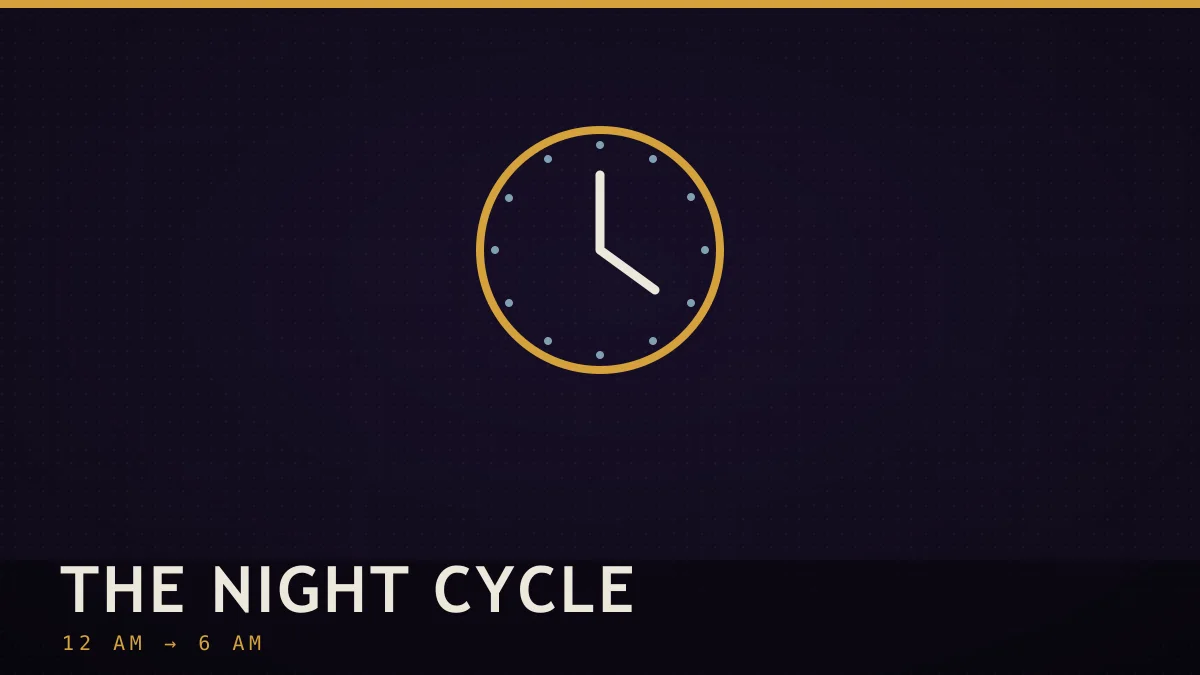
The night cycle is the heartbeat of Lurking Giants. There is no health bar to manage and no map objective to chase — there is only the night cycle clock. It opens at 12:00 AM and your entire job as a survivor is to still be breathing when it reaches 6:00 AM. What turns that waiting game into a horror game is the visibility pulse buried inside the night cycle. Whether you are prey or the giant, every decision you make in Lurking Giants is timed against this one clock, so it is the first system worth learning and the last one you stop thinking about.
How the night cycle works
Every match is a single night. The clock starts at 12:00 AM and every survivor's only goal is to still be alive when it strikes 6:00 AM. The danger is not a constant chase — it is the visibility pulse that fires at the top of each hour. A full night runs about six minutes of real time, roughly a minute per in-game hour. The tension of the night cycle is built entirely from the pulses: five moments, one at the top of each hour, when hiding stops working and everyone has to move. Learn the night cycle and the rest of the game follows.
- 12:00 AM Night falls
The round begins. The giant spawns from its television and survivors receive a lantern and flashlight.
- 1:00 AM First pulse
Every survivor is highlighted for the giant for a few seconds. Cover does not hide you during a pulse — you must already be moving to your next spot.
- 2:00 AM Second pulse
Another highlight. The early game is over; the giant now has two reads on where people cluster.
- 3:00 AM Third pulse
The midpoint. Giants start camping the chokepoints they learned from the first two pulses.
- 4:00 AM Fourth pulse
Survivor numbers usually thin here. Space out — a highlighted group is a free multi-kill.
- 5:00 AM Final pulse
The last highlight of the night. Survive this window and you are almost home.
- 6:00 AM Sunrise
No pulse. The sun rises and every living survivor wins the round.
The visibility pulse
A visibility pulse highlights all survivors globally and lets the giant see them through partial cover. There is no pulse at 6:00 AM — that is the win. During those few seconds the giant sees every survivor through bushes, walls and darkness alike. Crouching, lantern discipline and a perfect hiding spot all count for nothing mid-pulse — the pulse is a hard relocation deadline, not something you can hide through.
The one rule that keeps you alive: one spot per pulse. Never sit in the same hiding place across two highlights — the giant learned where you were and will be waiting.
Reading the night cycle as a survivor
Good survivors treat the night cycle like a metronome. In the early hours (1:00–2:00 AM) the giant is still gathering reads, so spread out and scout your relocation routes. By the midpoint (3:00 AM) the giant starts camping the chokepoints it learned, so avoid the obvious corridors. In the final stretch (4:00–5:00 AM) the survivor count is thinning and a highlighted cluster is a free multi-kill — put distance between yourself and everyone else, survive the 5:00 AM pulse, and you are almost always home.
Read the night cycle by counting pulses, not the hour hand — you only need to clear five highlights to reach 6:00 AM. Route each relocation a beat ahead: on the Forest chain tree lines into a perimeter loop; on the City climb a tower between pulses and drop before the next lands. The map sets how far you travel per beat, but the night cycle sets when you move.
The full survivor playbook, including cover types and lantern rules, is in the how to survive guide.
Reading the night cycle as the giant
For the giant, the night cycle's pulse is your best tool. Read the pulse, sprint to intercept the survivors it reveals, haunt their exit, and attack on arrival. Between pulses you are hunting blind, so bank the intel each highlight gives you: note where survivors cluster, then use the next pulse to path onto the ones who failed to move. The giant guide covers the Attack and Haunt combo that closes those chases.
Exploit the same schedule the survivors read. The night cycle spaces its pulses evenly, so the instant one ends you know when the next arrives — use that gap to pre-position near the cluster the last pulse exposed and haunt its exit a beat early.
The last hour before sunrise
The 5:00 AM pulse and the sprint to 6:00 AM are the tensest part of the night cycle. The survivor pool has thinned, so any two players caught in the same highlight hand the giant a kill it cannot afford to miss. Sunrise carries no pulse, so that last highlight is the giant's final free read. Break from everyone still alive and outlast the night cycle to dawn.
Frequently asked questions
How long is a round in Lurking Giants?
A full night in Lurking Giants runs about six minutes of real time — roughly one minute for each in-game hour. The night cycle opens at 12:00 AM and ends the instant the clock strikes 6:00 AM sunrise, so most rounds are decided inside that tight six-minute window.
What is a visibility pulse?
It is the moment hiding no longer helps. At the top of every hour from 1:00 to 5:00 AM, the night cycle lights up every survivor for the giant for a few seconds — no bush, wall or dark corner conceals you. Move before it fires, because a stationary survivor is a marked one.
How do you win Lurking Giants as a survivor?
Outlast the night cycle. Stay hidden and keep relocating through all five pulses until the clock reaches 6:00 AM — sunrise carries no final pulse, so simply reaching it is the win. Every survivor still breathing at dawn takes the round together; the giant only needs the night to end you first.
Want to sync the pulses live? Try the night cycle timer.